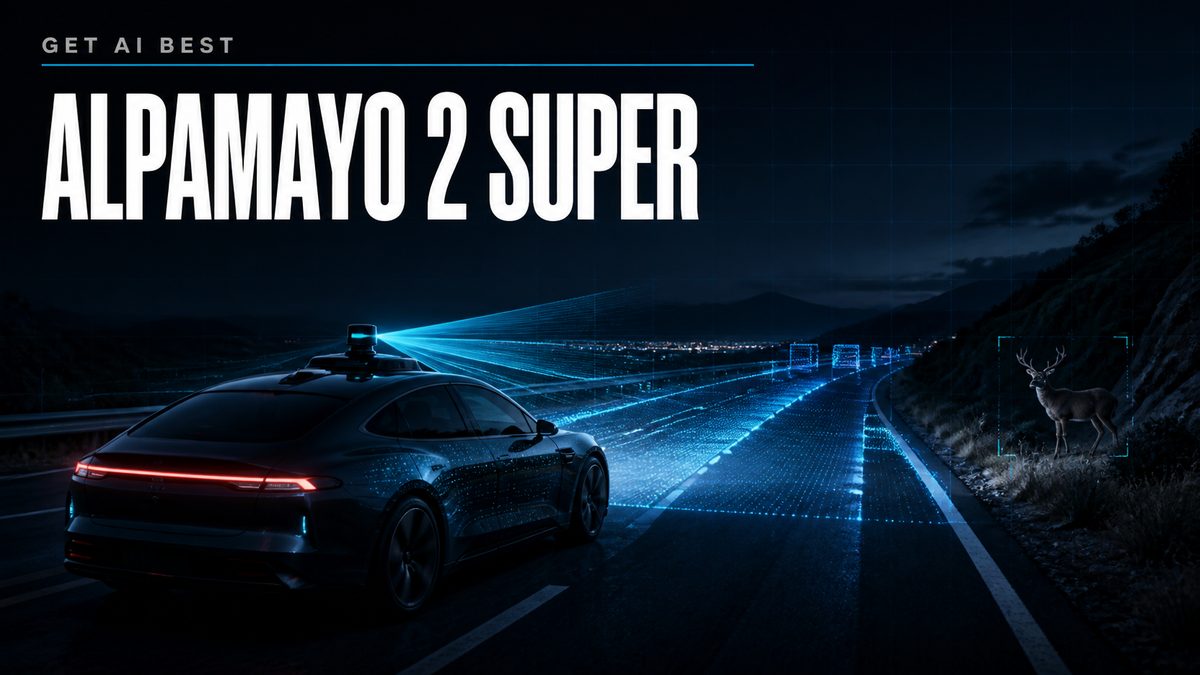
The long tail of driving, the rare and unusual road situations that standard datasets underrepresent, is the specific target of NVIDIA’s Alpamayo 2 Super, released August 5, 2026. It is a 34B-parameter vision-language-action (VLA) model built for autonomous driving, with weights under the Linux Foundation’s OpenMDW-1.1 license and code under Apache 2.0, meaning it is commercially usable from day one. Weights use the Linux Foundation’s OpenMDW-1.1 license and code is Apache 2.0, meaning it is commercially usable from day one.
The “Super” naming signals the tier: this is the high-capability variant of the Alpamayo 2 line, aimed at robotaxi and autonomous-driving development rather than research experiments. For teams building autonomous systems, an open 34B VLA model from NVIDIA changes the starting point of the stack.
What Alpamayo 2 Super Does
Alpamayo 2 Super is a vision-language-action model: it takes visual input (what the vehicle’s sensors see), understands it through language-aligned representations, and outputs actions (driving decisions). The VLA approach is the current frontier architecture for autonomous driving, replacing the older pipeline of separate perception, prediction, and planning modules with a model that maps perception to action end-to-end.
The specific design choices:
- 34B parameters. Large enough for serious driving competence, small enough to be deployable and fine-tunable by development teams.
- Long-tail focus. The model is explicitly built to handle rare events — unusual objects, edge-case road users, unexpected situations — the cases that define the gap between demo driving and production driving.
- Open licensing. Weights under OpenMDW-1.1 (Linux Foundation) and code under Apache 2.0 mean commercial use, modification, and redistribution are permitted from release day.
- Robotaxi and AD targeting. The positioning is explicit: this is for autonomous-driving development, not a general-purpose robotics model.
Why the Long-Tail Focus Matters
The cliché about autonomous driving is that the last 1% of scenarios take 99% of the effort. Alpamayo 2 Super’s design acknowledges exactly that: the named target is long-tail events, the situations that are rare in data but catastrophic in reality.
A VLA model trained on common situations handles the easy 95% well. The value , and the difficulty , is in the long tail: the pedestrian behaving unpredictably, the unusual cargo, the weather-degraded scene. Building a model whose explicit design target is that distribution is the right architectural bet, and it is why the release matters beyond the parameter count.
Where It Excels
Open licensing with commercial use. OpenMDW-1.1 + Apache 2.0 is the most permissive mainstream combination for this kind of asset. Teams can build products on it without legal gymnastics.
Right-sized architecture. 34B is a pragmatic middle ground: capable enough to matter, tractable enough for real teams to fine-tune and deploy, unlike the frontier-scale models that are only accessible to labs.
Named long-tail competence. An explicit design focus on edge cases is more useful than a generalist model that handles them accidentally.
Ecosystem leverage. NVIDIA’s driver, toolkit, and hardware stack around autonomous driving means the model plugs into an existing development ecosystem, not a vacuum.
Where It Falls Short
Long-tail claims need validation. “Built for long-tail events” is a design statement. Whether the 34B model genuinely handles rare scenarios better than alternatives requires independent testing on edge-case benchmarks , expect that evidence to be the conversation for the next several months.
VLA is not a complete driving stack. A VLA model handles perception-to-action mapping; the full robotaxi stack includes safety layers, redundancy, and regulatory compliance that no model release covers.
Benchmark-driven comparisons are still early. The competitive field of open driving models is moving fast, and week-one comparisons rarely reflect deployment reality.
Who Should Use It
Autonomous driving development teams. If you are building robotaxi, ADAS, or driving simulation systems, an open 34B VLA baseline from NVIDIA is the most practical starting point available.
Simulation and testing teams. Long-tail event simulation is a natural fit , generate edge cases, test the model’s response, iterate on the distribution.
Researchers in embodied AI. VLA is the frontier architecture for vision-to-action systems; the open release gives the research community a strong shared baseline.
How It Compares
vs. closed autonomous-driving stacks: Closed systems (Tesla FSD, commercial robotaxi platforms) are vertically integrated and production-proven but opaque and not accessible for development. Alpamayo 2 Super is the open alternative , you get the architecture, you do the integration.
vs. other open VLA / driving models: The differentiators are the 34B size tier and the explicit long-tail focus. Whether it beats comparable open models on edge-case benchmarks is the open question.
Bottom Line
Alpamayo 2 Super is the most practical open VLA model release for autonomous driving so far: a 34B, commercially usable, long-tail-focused baseline backed by NVIDIA’s ecosystem. For teams building driving systems, it is a legitimate starting point instead of a from-scratch build.
The honest read: the release sets a high bar for the open-driving-model category, and the evidence that matters , independent long-tail evaluation , is exactly what comes next.