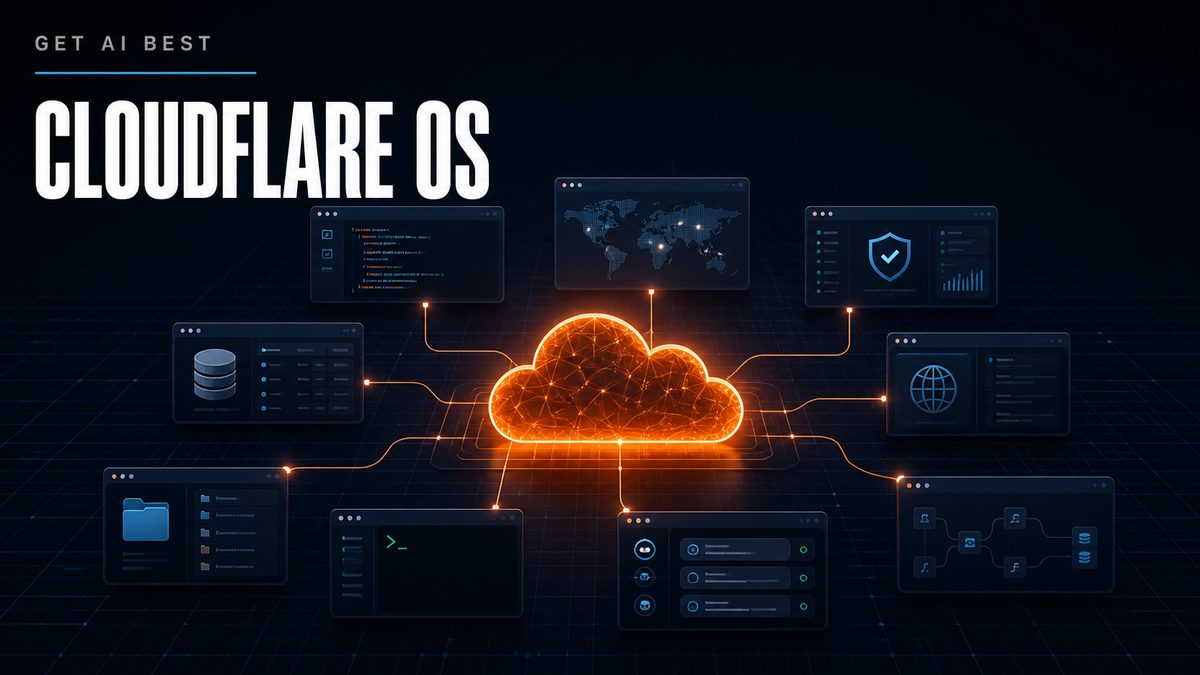
A single governed environment for running agents, internal apps, and work tools. That is what Cloudflare OS offers, open-sourced on August 5, 2026, where every employee gets a workspace in which AI agents act on company context and skills, in isolated runtimes under a security framework built for AI-era collaboration.
The notable part is what Cloudflare says it learned internally: the platform has been running for thousands of employees, and the new release rebuilt its security foundations around the information-exposure risks of agent collaboration. This is not a wrapper around existing tools — it is Cloudflare’s own operating layer for work, opened to everyone.
What Cloudflare OS Does
Cloudflare OS is the company’s bet on how work happens when agents are part of the team. The pieces:
- Agent workspaces. Each employee gets a workspace where AI agents act on company context and skills — the agent operates with the user’s data and tools, governed by policy.
- Isolated runtimes. Agents run in isolated environments, so a misbehaving agent cannot reach beyond its scope.
- Security governance framework. The platform defines what agents can touch, and , critically , what they can expose. Cloudflare says the open release rebuilt this layer around the information-exposure risks that emerged during internal use.
- Personal apps that can be shared and modified. Employees build small apps; the platform makes them shareable and editable within governance bounds.
- Built on Workers and Access. It composes Cloudflare’s existing infrastructure , the same edge network and identity layer Cloudflare already runs.
The origin story matters: it started when Cloudflare’s sales team used AI to build an internal “SuperApp,” and the demand spread across the company. The platform was then productized under five principles , including “humans own the output” and “AI does not expand permissions.”
Why the Security Foundation Is the Real Story
The most important sentence in the release is the one about rebuilding the security base for collaboration risks. Agent platforms fail in a specific way: each agent is fine in isolation, but when agents share context, skills, and data, the exposure surface multiplies. One agent’s output becomes another agent’s input, and permissions can compound in ways nobody designed.
Cloudflare’s answer , an explicit governance layer over agent workspaces , is the pattern the industry is converging on, and it arrives in the same week as two major agent-incident reports (OpenAI’s agent swarm disclosure and the UK AISI’s incident report). The market context makes this release timely: organizations adopting agents now need the control layer to go with them.
Where It Excels
Security as the foundation, not an add-on. The five principles , humans own output, AI does not expand permissions, and the rest , are the right axioms for agent platforms. Most competitors bolt security on later.
Real internal track record. Thousands of Cloudflare employees have used it daily. That is a deployment signal most enterprise platforms cannot claim at launch.
Open source. Any organization can deploy it and connect internal systems , no lock-in to Cloudflare’s SaaS for the platform itself.
Built on proven infrastructure. Workers and Access are battle-tested at Cloudflare’s scale. The agent layer inherits that reliability and identity model.
Where It Falls Short
Enterprise migration cost. “Deployable by any organization” is not the same as “easy to deploy.” Connecting internal systems and defining governance rules is real work, and the platform’s value depends on how well that initial setup is done.
New category, new expectations. Agent operating systems are a young category. The governance model will evolve, and early adopters will absorb the iteration cost.
Tension between openness and control. The platform’s whole value is governed collaboration, but every governance decision is a trade-off against agent usefulness. Finding the right balance per organization is a continuous exercise, not a one-time config.
Who Should Use It
Organizations already adopting agents. If your teams are using AI agents on company data and you are worried about what they can see and share, this is the control layer purpose-built for that problem.
Platform and IT teams building internal AI infrastructure who want an open foundation instead of closed enterprise suites.
Companies with strong Cloudflare footprints , the Workers and Access integration makes adoption natural.
How It Compares
vs. closed enterprise agent platforms: Cloudflare OS is open and self-hostable, with governance that is inspectable and modifiable. Closed suites are easier to buy but opaque , you trust the vendor’s governance model.
vs. internal “build it yourself” approaches: This gives teams the working platform Cloudflare spent years developing, with its security lessons baked in, instead of starting from zero.
vs. the agent-access-control literature: The release ships alongside Cloudflare’s Agent Access Model paper, which formalizes the “don’t trust the run” authorization model. The platform is the practical implementation of that research.
Bottom Line
Cloudflare OS is the most credible open answer yet to the question every agent-adopting organization is about to face: how do you let agents work on real company data without letting them expose it?
The honest read: the platform’s real value is the governance layer, and its real proof is the internal track record. The cost is the deployment and policy work every organization has to do for itself. For teams already betting on agents, this is the foundation worth evaluating before building your own.