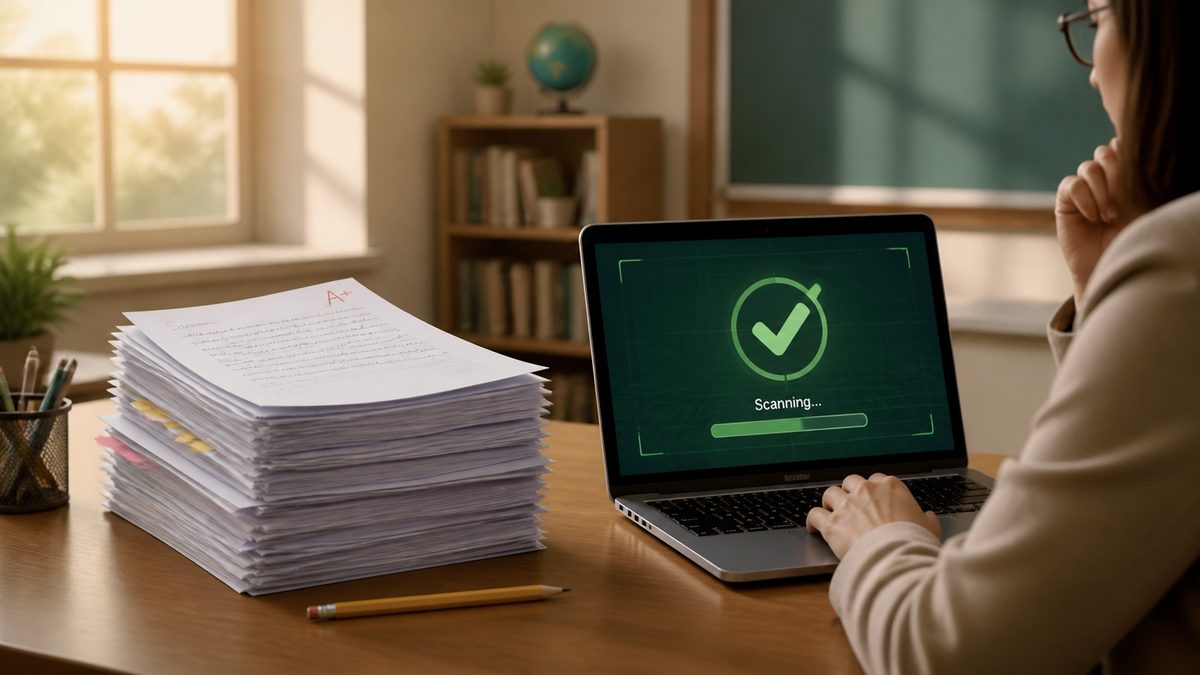
Teachers got handed a new job in the AI era: decide whether a student actually wrote this. The tools split into free student-facing checkers and paid institutional platforms, and accuracy varies more than the marketing suggests.
The Two Kinds of Detectors
There are two very different products hiding under the label “AI detector.” Free web checkers like GPTZero scan a pasted essay and return a probability score. Institutional platforms like Turnitin and Originality.ai sit inside the grading workflow, integrate with Google Classroom or Moodle, and scale to a whole school. A teacher ends up needing different things from each.
GPTZero: The Free Default
GPTZero is the most popular free option, built with teachers as the primary audience. Its AI detector claims 99% accuracy and covers the major models, from ChatGPT to GPT-5, Gemini, Claude, and Llama. The education angle is explicit: the “I’m an Educator” path is free, and there is a Chrome extension that adds detection to Gmail, Google Docs, and Classroom.
The practical strength is that it detects AI content and flags hallucinations and writing quality in the same scan, which turns a binary “AI or not” verdict into a fuller picture of the essay. The practical weakness is that no detector is reliable on short text: GPTZero and its peers explicitly say accuracy drops below a few hundred words.
Originality.ai: Built for Scale
Originality.ai positions itself as the most accurate detector in third-party studies and covers the newest models, including GPT-5.6, Claude Fable 5, Gemini 3, Kimi K3, and DeepSeek V4. You get three free AI scans per day, up to 2,000 words each, which is enough to try it honestly.
For schools, the difference is workflow. Originality.ai has a Moodle plugin, a Google Classroom integration, and an AI Allowance setting that flexibly treats some AI use as acceptable, which is the conversation most schools are actually trying to have. Bulk scanning and per-student accounts are paid, but the free scans are not a teaser: they are a usable check.
What the Accuracy Numbers Actually Mean
Every vendor quotes its own study, and the honest takeaway is that detection accuracy is high on long, fully AI-generated text and much lower on short text, translated text, or essays that mix human and AI writing. Teachers should treat a detection score as a conversation starter, not a verdict. A student who polished their own draft with an AI grammar pass will flag differently from one who pasted a whole essay.
How Schools Should Decide
A school rolling this out needs to choose between a free tool that teachers run ad hoc and a paid platform with a shared dashboard. The free route works for individual teachers, but it produces no institutional record and no consistent policy. The paid route gives you audit trails and shared settings, at a per-seat cost that scales with the school, not the semester.
The Bottom Line
Start with GPTZero’s free educator tier for spot checks. Add Originality.ai if your school wants classroom integration and audit trails. And keep expectations calibrated: for an honest comparison of what detectors can and cannot do, including where they lose to humanizers, our analysis of GPTZero vs Originality.ai walks through the tests that matter.