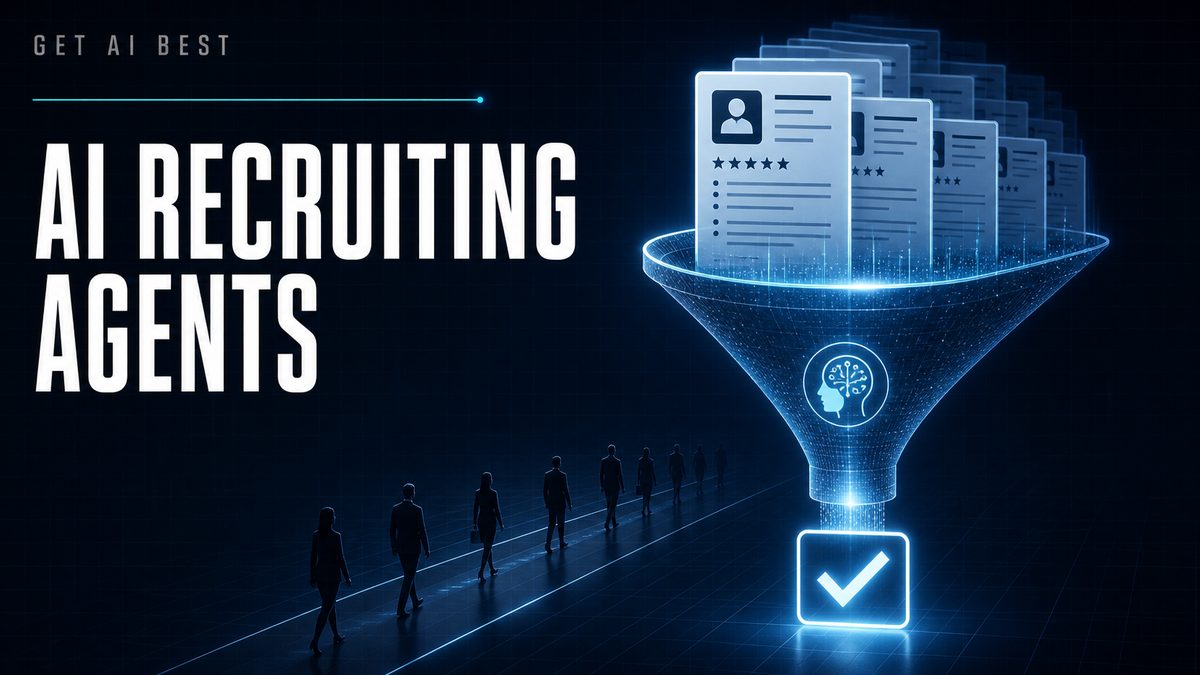
The hiring stack of 2026 runs partly on agents. AI recruiting agents have moved from novelty to a standard part of that stack, covering sourcing, screening, scheduling, and candidate communication, with agentic tools that don’t just suggest candidates but actually run parts of the process: sourcing from multiple channels, pre-screening with conversational interviews, and keeping candidates engaged through the pipeline.
The honest picture: the best tools genuinely compress the time spent on repetitive recruiting work, but they are assistants, not replacements — the judgment calls, the candidate experience, and the final decisions still belong to humans. The difference between a good and bad deployment is mostly process design, not software.
What AI Recruiting Agents Do
Recruiting agents in 2026 span the hiring workflow:
- Sourcing. Scanning job boards, professional networks, and databases to surface candidates matching a role, including passive candidates who would not appear in a standard search.
- Screening. Conversational pre-screening that asks role-relevant questions, collects answers, and summarizes candidate fit before a human interview.
- Scheduling. Coordinating interviewer and candidate calendars, sending reminders, and handling reschedules automatically.
- Candidate communication. Keeping candidates informed through the pipeline: status updates, next steps, and answers to common questions.
- Resume and application processing. Parsing applications, extracting structured data, and ranking candidates against the job spec.
The agentic difference: where older tools produced lists for a human to work, the current generation completes workflow steps — a sourcing agent that also reaches out, a screening agent that interviews and scores.
Why the Category Matters Now
Three forces made recruiting agents practical in 2026.
First, cost pressure. Recruiting is expensive per hire, and the repetitive parts — sourcing, screening, scheduling — are where hours go. Automation that compresses those stages pays for itself quickly.
Second, candidate volume. Application volumes keep rising, and screening every qualified applicant with humans alone is no longer feasible. Agents scale the early pipeline.
Third, agent capability. The current generation can hold conversations, follow workflows, and coordinate with other tools — enough to run real process steps, not just recommend them.
The result: the competitive question for hiring teams has shifted from “should we use AI recruiting tools” to “which parts of the process should stay human.”
Where These Tools Excel
Time compression in early pipeline stages. Sourcing and screening are the highest-hour, lowest-judgment parts of recruiting, exactly what agents compress.
Consistency of first-pass screening. An agent applies the same questions and criteria to every candidate, removing first-round interviewer variance.
Speed of response. Candidates hear back faster, which directly affects acceptance rates in competitive markets.
24/7 coverage. Candidate outreach and scheduling run outside working hours, which matters for international hiring.
Where They Fall Short
Quality of judgment. Agents screen against explicit criteria well; they miss the implicit signals a good recruiter catches in a conversation — motivation, cultural fit, career narrative.
Candidate experience risk. A poorly designed automated process reads as a black hole. Candidates notice when a human never touches their application.
Bias and fairness concerns. The criteria the agent scores on encode the team’s assumptions. Without deliberate design, automation can amplify existing bias at scale.
Integration overhead. Sourcing, screening, and scheduling agents only deliver when they connect to your ATS and communication channels — integration is where deployments succeed or stall.
The Main Tools
The 2026 market splits into four groups. AI features inside ATS platforms are the easiest entry point: Lever’s AI scores candidates and suggests next steps, and Greenhouse offers similar automation inside the workflow recruiters already use. HireVue focuses on video assessments and AI-powered evaluation, strong for structured interviews where you want consistent, comparable candidate responses. Paradox is the conversational specialist, known for chatbots that engage candidates, answer questions, and qualify them for high-volume and hourly hiring. Finally, newer specialist agents run end-to-end sourcing and outreach, finding candidates, sending personalized messages, and managing the first conversation — powerful, but they require careful guardrails to avoid spamming candidates.
The right choice depends on where your bottleneck is. If you drown in resumes, screening tools help most. If your team spends all day scheduling and emailing, communication agents deliver the biggest relief. If you want a single system, end-to-end platforms consolidate everything but demand the most setup.
What It Costs in 2026
Recruiting agent pricing spans a wide range. ATS add-ons typically run $20 to $50 per seat per month. Specialist screening and sourcing tools run $100 to several hundred dollars a month depending on volume. End-to-end platforms are the most expensive, often enterprise-priced. The practical starting point is lower than you might think: the built-in AI in an existing ATS is often included or cheap, and a screening tool for a team that hires a few people a month can cost less than the hours it saves in resume review.
The real cost, though, is not the software — it is the setup and oversight. Configuring screening criteria, reviewing the agent’s decisions, and auditing for bias take time. Teams that budget only for the subscription and not for the oversight discover the hidden cost later. The same pattern shows up across agent categories, from AI voice agents for customer service to Jotform’s AI agents: deployment discipline, not the tool, determines the return.
Who Should Use Them
High-volume hiring teams (sales, support, hourly roles) where sourcing and screening volume is the bottleneck.
Startups and small teams without a full recruiting operation, who need pipeline coverage without hiring recruiters for every function.
Agencies and RPO providers running recruiting at scale, where process efficiency is the margin.
Not for: executive and senior technical hiring, where relationship-based sourcing and deep judgment dominate — for now.
How to Deploy Them Well
The pattern that works in 2026:
1. Keep the agent in defined stages. Sourcing, screening, scheduling — not “the whole process.”
2. Set explicit criteria first. Write the screen questions and scoring rubric before turning the agent on.
3. Human review at the right points. Agents hand off shortlists; humans make the call. The design question is where the handoff happens.
4. Measure candidate experience. Track response times, drop-off, and feedback — automation that damages the brand costs more than it saves.
Bottom Line
AI recruiting agents are a real, maturing category. The tools genuinely compress sourcing, screening, and scheduling work, and the best deployments deliver measurable time savings and faster response times. Costs are modest at the entry level — ATS add-ons from $20 to $50 per seat — and the main investment is setup and oversight, not licenses.
The honest verdict: they are at their best in defined, high-volume stages with explicit criteria and human handoffs, and at their worst when deployed as an end-to-end black box. The teams that win with them treat the agent as the pipeline’s engine and the human as its judgment. That division of labor, not the software itself, is what separates a good AI recruiting deployment from a costly experiment.